Mind Wandering as a Trigger for Self-Regulation of Learning
10/2026
·
0 min read
Abstract
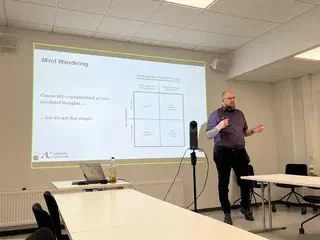
This presentation presents a theoretical framework integrating mind wandering, meta-awareness of mind wandering, and self-regulated learning (COPES facets), and two studies exploring reactions following mind wandering during video-based learning. Study 1 was a naturalistic study in an authentic course setting observing rewinding following self-caught thought reports; Study 2 was an experiment testing whether rewinding following mind wandering balances out the effect of frequent mind wandering on knowledge test scores. Results indicate that higher Online Effort Regulation relates to fewer thought reports in both studies, that rewinding rarely occurs, and that all relationships are in the opposite direction to what was expected. The presentation proposes that ad-hoc regulation following mind wandering only occurs if mind wandering is perceived as a threat to goal achievement, and outlines current work studying mind wandering in relation to goals set by learners, as well as future directions widening the scope beyond mind wandering to triggers for self-regulation more generally.
Date
10/2026
Event
Learning and Learning Processes, Faculty of Education and Psychology, University of Oulu
Location
Oulu, Finland