Self-regulated learning and off-task thoughts in online learning: Investigating the interaction during learning from videos

Abstract
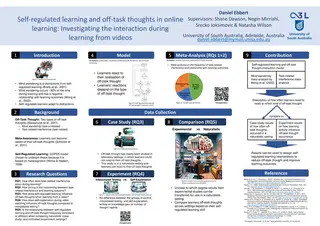
Self-regulated learning is critical for success in online learning. However, students inevitably experience off-task thoughts (mind wandering) that can disrupt learning. Although these two factors have been studied independently, the relationship between self-regulated learning and off-task thoughts has not been studied extensively. This research explores the relationship between self-regulated learning and off-task thoughts while learning online from a video. A mixed methods approach combines conceptual analysis, meta-analysis, a case study, experiment, and comparative analysis to investigate off-task thought frequency and its influence on self-regulation processes. A model of how off-task thoughts may prompt reactive self-regulation during learning will be presented in a conceptual paper. Meta-analysis will synthesise the occurrence and impact of task-related interference. A naturalistic case study and controlled experiment will gather self-caught thought reports during actual and simulated video learning. Comparing results will assess generalizability across contexts. This research will provide theoretical and empirical insights into the relationship between off-task thoughts and self-regulated learning when learning from videos.
Authors
Daniel Ebbert
Date
03/2024
Type
Publication
14th International Learning Analytics and Knowledge Conference (LAK'24), Kyoto, Japan
Event
Location
Kyoto International Conference Center, Kyoto, Japan
This poster resulted from my PhD and is related to the associated doctoral consortium proceeding.