
Daniel Ebbert

Daniel Ebbert

(he/him)

Research Fellow

Adelaide University

Professional Summary

I am a Research Fellow at Adelaide University’s Centre for Change and Complexity in Learning. In my doctoral research, I explored the intersection of self-regulated learning and mind wandering during video-based learning, specifically examining how learners adapt their learning processes after recognising mind wandering episodes. This research aimed to develop evidence-based recommendations for effective responses to mind wandering during learning. Following my PhD, I have begun researching educational technology to support cognitive and metacognitive processes during learning.

Education

PhD in Education

2022-08-01
2025-12-11

University of South Australia (now Adelaide University)

Master of Science in Technical Communication

2016-09-01
2017-08-01

University of Twente

Bachelor of Communication in Information Services and Management

2011-09-01
2015-07-01

Saxion University of Applied Sciences

Interests

self-regulated learning mind wandering metacognition learning analytics learning sciences open science
Recent Blog Posts
AI Research Assistant: Use Cases (5/5) featured image

AI Research Assistant: Use Cases (5/5)

Showcasing three practical use cases: claim verification, internal coherence, and learning from reviews with examples drawn from real research workflows.

avatar
Daniel Ebbert
•
AI Research Assistant: Agent Definition (4/5) featured image

AI Research Assistant: Agent Definition (4/5)

How to define your environment and your AI assistant's personality through AGENTS.md files and agent definitions.
avatar
Daniel Ebbert
•
Featured Publications
(2026). The (Un)Conscious Learner: How Meta-Awareness Influences Self-Regulated Learning and Mitigates Task-Unrelated Thoughts. Cognitive Science, 50(1), e70164.
Preprints
(2026). The Learner's Appraisal: What Are Students Thinking About When Their Mind Wanders?.
(2026). Rewind and Recall: Examining the Effects of Self-regulated Learning and Off-task Thought in Video-based Learning.
(2026). Meta-Awareness of Mind Wandering: Examining Effects of Self-Regulated Learning, Interpolated Testing, and Self-Explanation.
(2026). Task-Related Interference During Educational Activities: A Meta-Analysis of Its Occurrence and Relationship with Learning.
Recent Publications
(2026). Instructors’ perceptions of a large language model framework for generating automated multiple-choice questions from video transcripts. Educational Technology Research and Development.
(2026). Understanding the role of learning analytics and generative artificial intelligence on decision-making and learning design practice in higher education. International Journal of Educational Technology in Higher Education, 23, 43.
(2026). Assuring quality learning in a gen AI-integrated future: The role of adaptive capabilities. TEQSA.
(2026). Mind wandering in Video-Based learning: Self-Regulated learning and student responses in a naturalistic setting. Metacognition and Learning, 21, 6.
(2025). Exploring self-regulated learning and off-task thoughts during video-based learning. University of South Australia (now Adelaide University).
Talks
Build Your Own AI Research Assistant featured image

Build Your Own AI Research Assistant

AI tools have been marketed at researchers, be those Claude Science or OpenAI Prism, and many of our familiar tools now include AI features, whether we want them or not. In this …
avatar
Daniel Ebbert
•
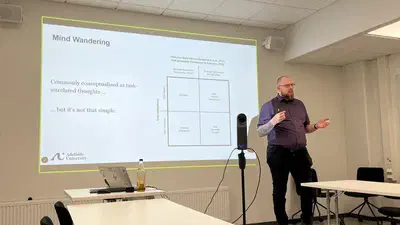
Mind Wandering as a Trigger for Self-Regulation of Learning featured image

Mind Wandering as a Trigger for Self-Regulation of Learning

This presentation presents a theoretical framework integrating mind wandering, meta-awareness of mind wandering, and self-regulated learning (COPES facets), and two studies …
avatar
Daniel Ebbert
•
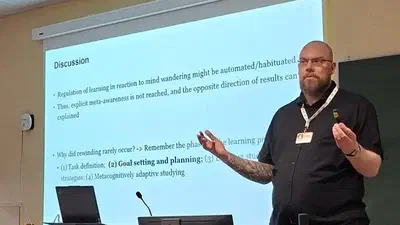
Mind Wandering, Self-Regulated Learning, and the Role of Goals in Relation to Thought Content featured image

Mind Wandering, Self-Regulated Learning, and the Role of Goals in Relation to Thought Content

This presentation presents findings from ongoing research investigating the relationship between mind wandering, meta-awareness, and self-regulated learning during video-based …
avatar
Daniel Ebbert
•
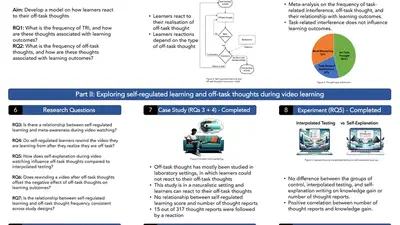
Self-Regulated Learning and Mind Wandering in Video-Based Learning: A Naturalistic Study featured image

Self-Regulated Learning and Mind Wandering in Video-Based Learning: A Naturalistic Study

Video-based learning is commonplace in higher education. While videos offer flexibility and convenience, they also require sustained attention. Learners frequently experience mind …
avatar
Daniel Ebbert
•
Posters
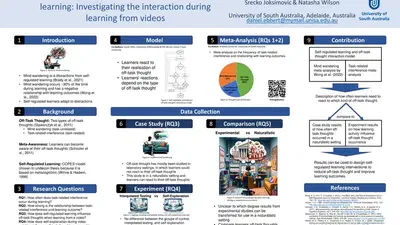
From Distraction to Reaction: Exploring Self-Regulated Learning and Off-Task Thoughts in Online Learning from Videos featured image

From Distraction to Reaction: Exploring Self-Regulated Learning and Off-Task Thoughts in Online Learning from Videos

This research explores SRL and off-task thoughts in online learning from videos. The author applies a multi-method approach (conceptual paper, meta-analyses, case study, …
avatar
Daniel Ebbert
•
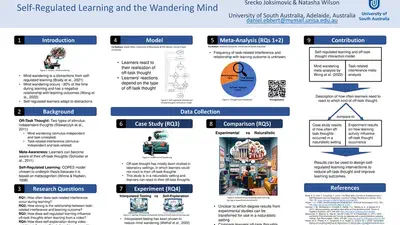
Self-regulated learning and off-task thoughts in online learning: Investigating the interaction during learning from videos featured image

Self-regulated learning and off-task thoughts in online learning: Investigating the interaction during learning from videos

Self-regulated learning is critical for success in online learning. However, students inevitably experience off-task thoughts (mind wandering) that can disrupt learning. Although …
avatar
Daniel Ebbert
•
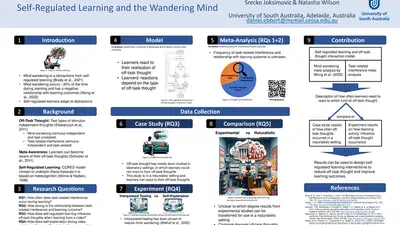
From Distraction to Meta-Awareness: Self-Regulated Learning and the Wandering Mind featured image

From Distraction to Meta-Awareness: Self-Regulated Learning and the Wandering Mind

Did you catch yourself thinking about something else while reading this program? You are not alone. This phenomenon is known as mind wandering, and it is inevitable. While …
avatar
Daniel Ebbert
•
From Distraction to Meta-Awareness: Self-Regulated Learning and the Wandering Mind featured image

From Distraction to Meta-Awareness: Self-Regulated Learning and the Wandering Mind

Did you catch yourself thinking about something else while reading this program? You are not alone, and it is perfectly normal to frequently think about something unrelated to a …

avatar
Daniel Ebbert
•